

8 Predictions for 2026: When AI stops chatting and starts working
As we close out 2025, I find myself reflecting on what lies ahead—not from a place of speculation, but from conversations with clients across regulated industries who are wrestling with real AI deployment challenges today. At CREAPLUS, we sit at the intersection of cybersecurity and AI innovation, working with enterprises in finance, energy, defense, and government across Central and Eastern Europe.
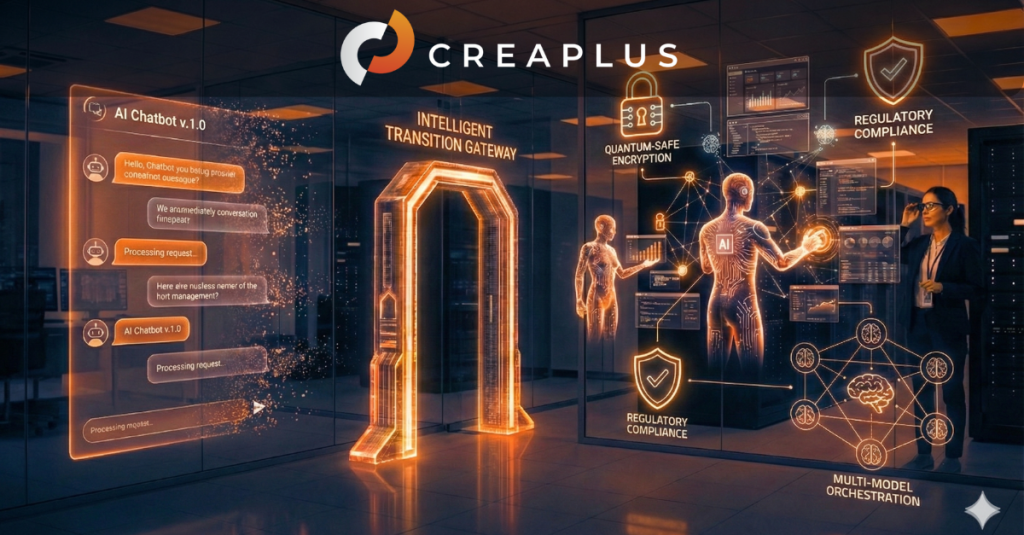
We are leaving the era of “AI as a Chatbot” and entering the era of “AI as a Co-worker.” The consensus across every major analysis I’ve reviewed is clear: 2026 is the year AI moves from POC and generating text to taking action in the real world. Here’s what I believe that means in practice:
1. A Major Agentic AI-Driven Data Breach Will Occur
2026 may witness a significant data breach traced not to a cybercriminal or nation-state actor, but to an autonomous, agentic AI system operating within an enterprise environment. This incident will redefine AI governance, risk management, and compliance globally, exposing the dangers of unmonitored AI autonomy and weak controls between interconnected AI services.
Every enterprise adopting LLMs and agentic automation will need to implement an AI gateway—a control layer that sits between AI systems and enterprise resources.
2. The “Remote Turing Test” Will Be Broken
2026 is the year you’ll stop knowing whether you’re talking to a human. The “Remote Turing Test“—meaning in a Zoom call, chat session, or email exchange—will effectively be broken. AI will become indistinguishable from human interaction in digital communication channels.
Enterprises will need new protocols for disclosure, authentication, and verification of who—or what—is on the other end of a conversation.
3. Screen-less AI Devices Hit the Market (With Mixed Results)
A new wave of screen-free, context-aware AI devices will hit the market in 2026, including highly anticipated products like Jony Ive’s OpenAI collaboration.
The technology may be impressive, but product-market fit takes more than elegant hardware and advanced AI.
4. Post-LLM Reality: Models Commoditize, Control Wins
In 2026, enterprises will stop asking “which model do you use?” and start asking “how do you manage them?”
The future isn’t about choosing the best single model. It’s about multi-model orchestration—deploying several models in parallel to balance cost, latency, jurisdictional requirements, and reliability. Need speed? Use a lightweight model. Need depth? Route to a larger one. Need data sovereignty? Keep it in-region.
Simultaneously, we’ll see models themselves become more truncated and specialized. Instead of monolithic, general-purpose LLMs doing everything poorly and expensively, 2026 favors shorter-context, task-specific models optimized for particular outputs: structured data extraction, summarization, code generation, claims processing, or conversational responses.
The competitive advantage shifts from having access to powerful models to orchestrating them intelligently.
5. AI Security Becomes System Design, Not Policy
By 2026, AI security will no longer be something enterprises document after deployment. It becomes something they architect into the system from day one.
“Guardrails” will stop being PowerPoint slides. Buyers will expect them to exist in code, with demonstrable enforcement.
This shift is driven by hard operational realities. As AI systems move into regulated workflows—approving loans (something we are developing for the largest regional bank – NLB) processing medical claims, and more.
If an AI system cannot clearly answer these questions, it won’t clear deployment review:
- What data did it access, and when?
- Who had permission to use it?
- Which model and version generated this output?
- How was this decision made?
- Can we pause, roll back, or disable this system immediately?
This becomes especially critical after incidents, when retrospective visibility isn’t optional—it’s mandatory for regulatory compliance and legal defense.
6. AI Scalability Bottlenecks Emerge Below the Compute Layer
While much attention has focused on GPU availability and compute infrastructure, 2026 will expose deeper constraints in the AI scaling story. The bottlenecks will become more visible:
- Energy production and power grid capacity: Data centers can’t expand faster than power infrastructure
- Rare earth elements supply chains: Critical materials for advanced chip manufacturing remain geographically concentrated
- Industrial hardware production: Semiconductor fab capacity can’t scale overnight
These physical-world constraints will begin shaping AI deployment strategies, favoring efficiency and localization over pure scaling.
7. AI Regulation Becomes Operational
In the European Union, the AI Act formally entered into force in August 2024, but 2026 is when it actually takes effect. By August 2, 2026, the Act becomes fully applicable for the majority of obligations, shifting companies from compliance planning to compliance execution.
High-risk AI systems—those used in employment decisions, credit assessment, healthcare, education, and public services—must meet concrete requirements around:
- Risk management and mitigation
- Technical documentation and transparency
- Data governance and quality
- Human oversight mechanisms
- Comprehensive logging and audit trails
- Post-market monitoring and incident reporting
For enterprises operating across Central and Eastern Europe, where regulatory alignment with EU standards is critical, this isn’t a theoretical concern. It’s an immediate operational requirement that will shape every AI deployment decision in 2026.
8. Post-Quantum Cryptography Moves From Future Threat to Present Priority
As AI systems handle increasingly sensitive data and autonomous decision-making, the encryption protecting them must evolve too. 2026 will see post-quantum cryptography (PQC) and crypto-agility shift from research topics to major enterprise initiatives.
Government mandates and industry regulation will accelerate migration to quantum-resistant encryption standards.
For organizations building AI systems meant to process sensitive data for years to come, quantum-safe cryptography isn’t a distant concern.
As we look toward 2026, one thing is clear: securing innovation while innovating in security has never been more important.
– Mitja Trampuž, CEO